
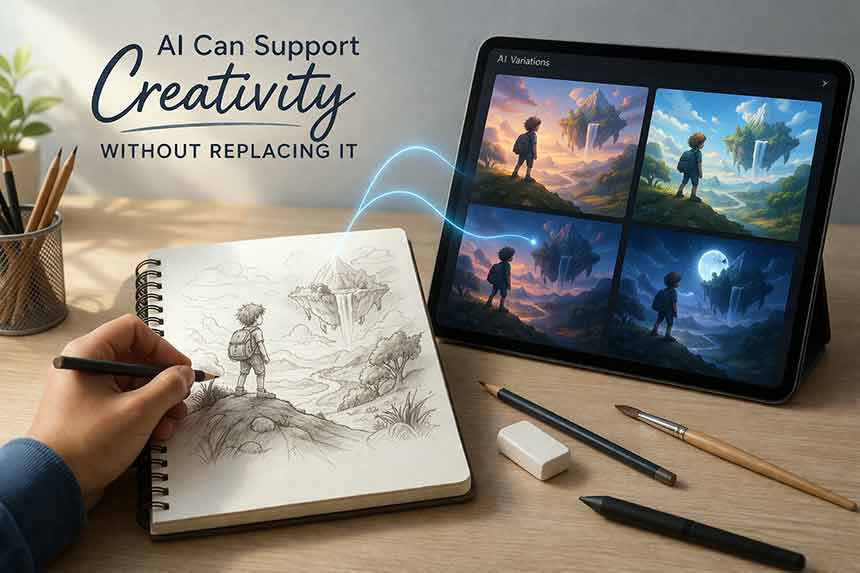
Artificial intelligence is quickly becoming part of many creative tools. Students see AI images online, and many wonder if technology will replace artists. In reality, strong creative work still begins with human thinking. AI can support the process by helping artists explore ideas, test directions, and study possibilities. But the imagination, decisions, and personal voice must still come from the artist.
The Changing Creative Toolbox
Artists have always used tools to expand their abilities. Paint brushes, cameras, computers, and digital tablets were once considered new technology. Over time they simply became part of the creative process.
Artificial intelligence is another tool entering the studio. It can generate images, suggest compositions, or help artists experiment with visual ideas quickly. These tools can be exciting, especially for students who are curious about technology.
But tools should always serve the idea. Creativity begins in the mind of the artist, not in the machine.
Where AI Can Help the Creative Process
AI can be useful when it supports exploration. Many artists use it as a brainstorming partner rather than a replacement for their work.
For example, AI can help with:
Idea exploration
Artists can quickly explore visual possibilities. A student investigating surreal landscapes might generate several unusual environments to spark new directions.
Lighting and atmosphere references
Artists often search for reference images to understand light, color, and mood. AI can generate environments that help students study how light behaves in different situations.
Composition exploration
Sometimes artists struggle with how to arrange elements. AI generated scenes can help students observe different visual structures and compositions.
Creative prompts
AI can also help students ask better questions. A simple prompt might lead to new story ideas or unexpected visual concepts.
In each case the technology is supporting curiosity, not replacing the artist.
Where Artists Still Lead the Work
Even with powerful tools, the most important parts of art cannot be automated.
Observation
Artists learn to notice details in the world. Light, gesture, expression, movement, and emotion come from careful observation.
Decision making
Artists choose what to include and what to remove. They decide how to organize shapes, color, and composition.
Personal voice
Strong artwork reflects the experiences, ideas, and perspective of the artist. This voice develops slowly through practice, experimentation, and reflection.
These qualities cannot be generated by a machine. They develop through the artist’s thinking and experience.
Helping Students Use AI Thoughtfully
Students are naturally curious about new technology. Instead of avoiding AI tools, educators can guide students in using them responsibly.
A few helpful classroom approaches include:
Use AI for inspiration, not final artwork
Students can explore ideas using AI but still create their own finished work.
Compare AI images with student work
This helps students analyze differences in composition, storytelling, and originality.
Ask students to explain their choices
When students describe their creative decisions, their thinking becomes clearer and stronger.
Encourage experimentation
Technology should open doors to exploration rather than replace creative effort.
These strategies help students see AI as a creative assistant rather than a shortcut.
Creativity Still Belongs to the Artist
Technology will continue to evolve. New tools will appear, and artists will keep experimenting with them.
But creativity has always come from curiosity, observation, and imagination. Those qualities belong to the artist.
AI can support the journey. It can spark ideas and help artists explore possibilities.
The real creativity still comes from the person holding the pencil, the brush, or the stylus.