
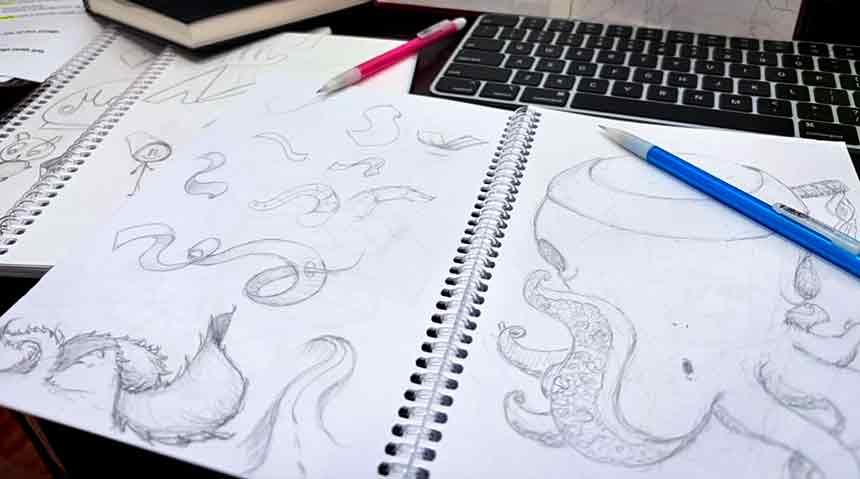
This component focuses on how students develop ideas, test materials, solve problems, and refine their work over time. Strong portfolios show evidence that students are not simply producing finished artworks, but actively investigating, questioning, and improving their artistic process.
Practice, experimentation, and revision are the driving forces that move a Sustained Investigation (SI) forward. Each artwork becomes an opportunity to test new approaches, strengthen technical skills, and deepen the connection to the central inquiry guiding the investigation.
Students who regularly question their work and intentionally explore new methods often develop the most compelling portfolios.
Using Questions to Guide Practice
One of the most effective ways to strengthen an SI is by continuously asking purposeful questions. These questions help guide practice and keep each artwork connected to the main investigation.
For example, students might ask:
How can the main SI inquiry be explored through different materials? Could the same concept be expressed using charcoal, ink, watercolor, digital painting, collage, or mixed media?
What would happen if the same subject were created using a completely different technique? Would the message or interpretation change?
How can the scale of the artwork influence the meaning of the investigation?
How can repetition of forms or imagery strengthen the visual idea?
How can the composition change to create stronger visual storytelling?
These types of questions encourage students to test ideas rather than repeat the same approach.
Experimenting with Materials and Techniques
The AP rubric values portfolios where students take creative risks and explore different possibilities. Experimentation allows artists to discover new visual solutions.
Students may explore questions such as:
How could layered materials help communicate the main SI inquiry?
Would transparent materials such as watercolor or ink washes create a different emotional tone than opaque paint?
Could texture be introduced through collage, thick paint, or mixed media?
What happens when drawing techniques are combined with photography or digital manipulation?
Does working in black and white create a stronger emotional impact than using color?
Experimentation is not about randomness. Each attempt should connect back to the central inquiry of the investigation.
Applying Color Theory to Strengthen Emotion
Color choices can dramatically influence the meaning of an artwork. Students should consider how color relationships support the emotional message of their SI.
Helpful questions include:
What emotions connect to the central idea of the investigation?
Would warm colors create energy, tension, or excitement?
Would cool colors communicate calmness, distance, or sadness?
Could complementary colors increase visual contrast and intensity?
How might a limited color palette strengthen the focus of the artwork?
Could color symbolism reinforce the investigation’s concept?
Intentional color choices show that the artist is making thoughtful decisions rather than simply decorating the artwork.
Practicing Skills Within the Investigation
Practice also includes developing the technical skills needed to communicate ideas clearly. Students should use their SI as an opportunity to strengthen drawing and observational abilities.
Students might ask:
How can drawing hands more accurately improve storytelling within the artwork?
How can facial expressions communicate emotions connected to the SI inquiry?
How can perspective or proportion make objects feel more believable?
What studies could be created to practice complex forms before including them in a larger composition?
How can lighting studies improve realism or mood?
Sketch studies, small experiments, and practice drawings are valuable parts of the creative process. These studies often lead to stronger final artworks.
Revising and Improving Artwork
Revision is an essential part of the AP process. Artists should review their work critically and look for ways to improve both the visual quality and the conceptual connection to the SI.
Students can reflect by asking:
Does this artwork clearly connect to my main investigation inquiry?
What part of the artwork feels strongest?
What part feels unresolved or unclear?
Would changing the composition improve the visual impact?
Could additional layers, textures, or details strengthen the message?
What feedback from teachers or peers could help refine the piece?
Revision demonstrates that the artist is thinking deeply about their work and actively improving it.
Growth Through the Artistic Process
The most successful AP Art portfolios show a clear journey of artistic growth. Practice strengthens skills, experimentation expands possibilities, and revision refines ideas.
When students consistently explore new approaches, ask thoughtful questions, and improve their work over time, they create portfolios that not only meet the AP rubric expectations but also reflect a meaningful artistic investigation.
Practice, experimentation, and revision are not separate steps. They form a continuous cycle that helps artists discover stronger ideas, deeper meaning, and more powerful visual communication.