
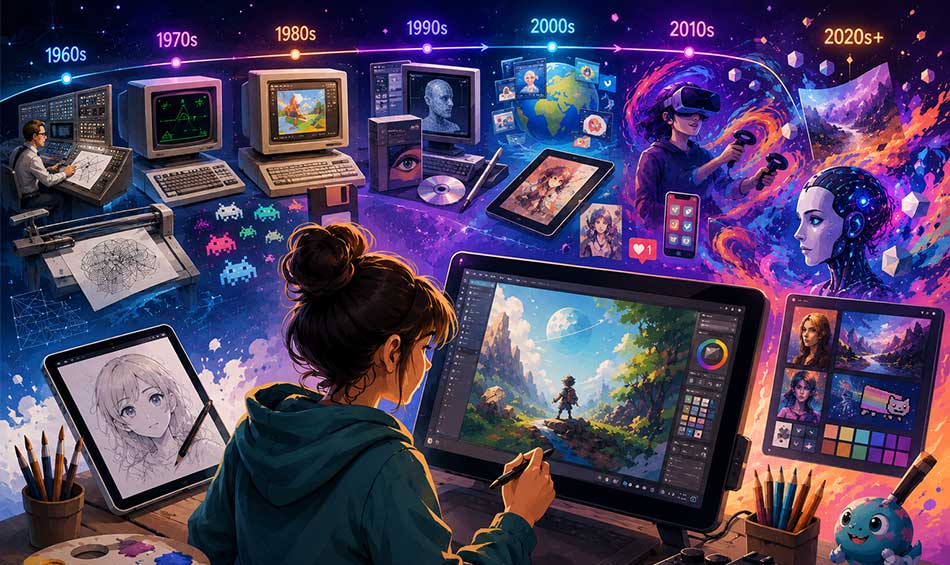
Today, artists can create entire worlds using a tablet, a computer, or even artificial intelligence. Digital art has transformed from simple glowing pixels into one of the most powerful creative movements in history.
From early computer experiments in the 1960s to today’s AI-generated masterpieces, digital art continues to reshape how humans imagine, design, and communicate.
Here is the fascinating timeline of how digital art evolved from tiny pixels to intelligent machines.
The 1960s — The Birth of Computer Art
Long before Photoshop existed, scientists and engineers experimented with computers as creative machines. Early computers were enormous, expensive, and incredibly slow compared to modern devices. Yet artists saw potential.
One of the first digital artists was Frieder Nake, who used mathematical algorithms to create geometric artwork with plotter machines.
Instead of brushes, these artists used:
- code
- punch cards
- mathematics
- giant computers
The artwork often looked abstract and futuristic, filled with lines, shapes, and patterns.
Fun Fact:
Many early digital artworks were created by machines that physically drew with pens attached to robotic arms.
The 1970s — Pixels Enter the Scene
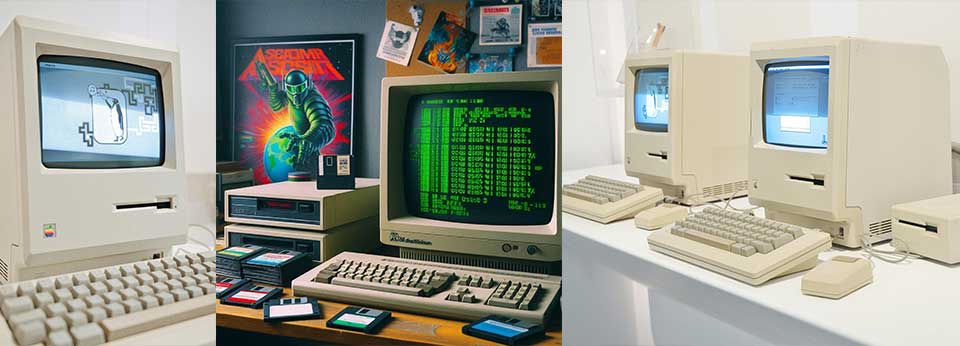
As computers slowly became more advanced, pixel-based graphics started appearing. A pixel is the smallest unit of a digital image.
Early computer screens had extremely low resolution, meaning artists had to create images using chunky square blocks.
Video games became one of the biggest influences on digital art during this era.
Games like:
- Pong
- Space Invaders
- Pac-Man
helped define the pixel art style that is still loved today.
Fun Fact:
Some classic game characters were designed with fewer pixels than a modern emoji.
The 1980s — The Digital Art Explosion
The arrival of personal computers changed everything.
Machines from companies like Apple and Commodore brought digital creativity into homes and schools.
Artists could now use:
- digital paint programs
- graphic design software
- scanners
- early animation tools
One major breakthrough was the launch of Adobe Photoshop in 1988, which revolutionized photo editing and digital painting forever.
Suddenly, artists could:
- layer images
- manipulate colors
- erase mistakes instantly
- combine photography with illustration
Fun Fact:
The first version of Photoshop was originally created to display grayscale images on a monitor.
The 1990s — The Internet Changes Art
The internet connected artists across the world for the very first time.
Digital creators could now:
- share artwork online
- build fan communities
- create web comics
- sell digital designs
This era also saw the rise of:
- 3D animation
- CGI movies
- digital photography
Films like Toy Story showed the world that entire movies could be created inside computers.
At the same time, graphic tablets became more popular, allowing artists to draw directly onto screens with stylus pens.
Fun Fact:
Toy Story was the first fully computer-animated feature film in history.

The 2000s — Social Media and Digital Creativity
The 2000s transformed digital art into a global movement.
Artists began posting work on:
- online portfolios
- forums
- social media
- video-sharing platforms
Creative careers exploded in:
- game design
- YouTube content creation
- digital illustration
- animation
- concept art
Software became more powerful, while drawing tablets became more affordable for students and young creators.
This decade also introduced mobile creativity. Smartphones and tablets allowed people to sketch and edit photos almost anywhere.
Fun Fact:
Many professional artists now create entire illustrations on tablets smaller than a school notebook.
The 2010s — Art Meets Virtual Reality and AI
Technology began blending creativity with immersive experiences.
Artists experimented with:
- virtual reality painting
- augmented reality
- interactive installations
- AI-assisted design
Programs could now help:
- color artwork
- remove backgrounds
- suggest edits
- generate patterns
Meanwhile, social media platforms transformed unknown artists into worldwide creators overnight.
Digital art styles became incredibly diverse:
- anime-inspired illustration
- minimalist design
- glitch art
- vaporwave aesthetics
- hyper-realistic digital painting
Fun Fact:
Some VR artists create paintings by literally walking around inside their artwork.
The 2020s — The Rise of AI Art
Artificial intelligence became one of the biggest creative debates in modern history.
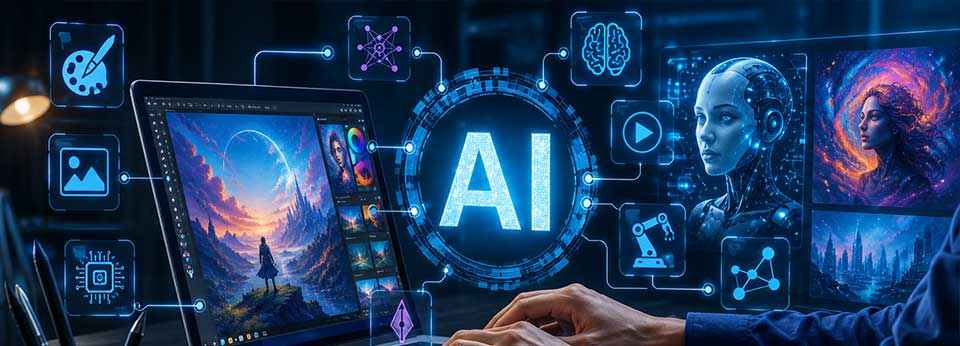
AI image generators can now create artwork from simple text prompts within seconds. This technology shocked both artists and the public.
Some people believe AI opens exciting creative possibilities. Others worry about:
- originality
- copyright
- artist ownership
- the future of creative careers
Despite the controversy, many artists use AI as:
- a brainstorming tool
- a reference generator
- a creativity assistant
The biggest question today is not whether AI will influence art — it already has. The real question is how artists and technology will continue evolving together.
Fun Fact:
Some AI systems are trained on millions of images to learn artistic styles and visual patterns.
Why Digital Art Matters
Digital art is more than technology. It is a reflection of how humans adapt creativity to new tools.
From cave walls to computer screens, artists have always evolved alongside invention.
Today’s young creators have access to tools that past generations could barely imagine:
- instant global sharing
- animation software
- digital sculpting
- AI-powered creativity
- virtual reality worlds
The next great artistic revolution may already be happening inside a classroom, a bedroom studio, or a student’s tablet.
Final Thought
The history of digital art is really the history of human imagination meeting technology.
What started as simple glowing pixels became:
- blockbuster movies
- video game worlds
- virtual reality experiences
- AI-generated creations
And this story is still being written.
The next chapter may belong to an entirely new generation of creative thinkers.