
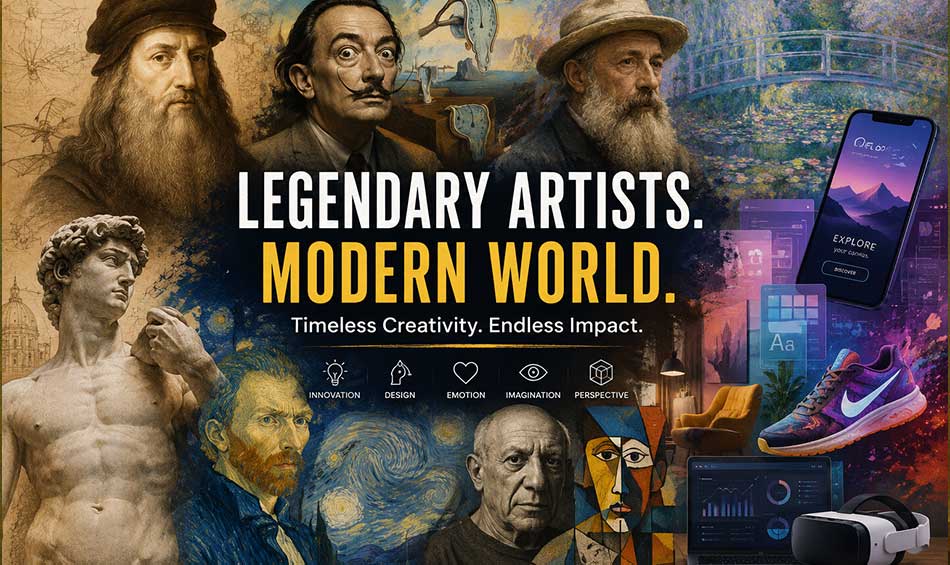
But their ideas didn’t stay in the past—they quietly evolved into the foundations of modern technology, business, design, and everyday life.
From the apps on your phone to the way companies design products and experiences, the influence of these legendary artists is everywhere.
Leonardo da Vinci: The Original Innovator
Leonardo da Vinci wasn’t just a painter—he was a scientist, engineer, and visionary. Centuries before modern technology, he sketched concepts for flying machines, robots, and submarines.
Why It Matters Today
Da Vinci’s greatest contribution wasn’t a single invention—it was his mindset: blending art with science.
Modern Impact
- Design Thinking & Innovation: Companies like Apple and Tesla thrive on interdisciplinary creativity.
- Medical Visualization: His detailed anatomical studies laid groundwork for imaging technologies used in medicine today.
- Robotics & Engineering: His mechanical sketches resemble modern robotic systems.
Real-World Example
Firms like IDEO use “human-centered design,” a process that mirrors da Vinci’s curiosity-driven approach to solving problems.
Salvador Dalí: The Power of Imagination
Salvador Dalí embraced the bizarre. His surreal, dreamlike paintings explored the subconscious, challenging reality itself.
Why It Matters Today
Dalí showed that the unexpected captures attention—and attention drives engagement.
Modern Impact
- Advertising & Branding: Surreal visuals are used to create unforgettable campaigns.
- AI Art & Creative Tech: Tools that generate strange, imaginative visuals echo Dalí’s style.
- Film & Storytelling: Non-linear, symbolic narratives dominate modern media.
Real-World Example
Brands like Nike and Apple often use surreal imagery in ads to stand out—an approach rooted in Dalí’s philosophy of visual disruption.
Claude Monet: Designing How We Feel
Claude Monet focused less on detail and more on how light and color create mood. He often painted the same subject dozens of times under different lighting conditions.
Why It Matters Today
Monet taught us that perception matters more than reality—what people feel influences how they behave.
Modern Impact
- User Interface Design (UI/UX): Color and lighting are used to guide user experience.
- Retail & Interior Design: Lighting affects customer behavior and mood.
- Photography & Social Media: Filters replicate shifts in light and atmosphere.
Real-World Example
Stores like IKEA and Target carefully design lighting and color schemes to influence how customers feel—and ultimately, what they buy.
Michelangelo: Mastering the Human Form
Michelangelo believed sculpture was the highest art form and devoted himself to understanding the human body in extraordinary detail.
Why It Matters Today
His work defined how we visualize strength, beauty, and realism.
Modern Impact
- 3D Animation & Video Games: Accurate human anatomy is essential for realistic characters.
- Fitness & Athletic Branding: The idealized body still shapes marketing and culture.
- Architecture & Engineering: His precision informs structural and aesthetic design.
Real-World Example
Studios like Pixar and Marvel rely on anatomical accuracy to create believable characters, while athletic brands like Nike use sculptural principles in product and advertising design.
Vincent van Gogh: Emotion as a Language
Van Gogh’s bold colors and expressive brushstrokes weren’t about realism—they were about feeling. Ironically, he gained little recognition during his lifetime.
Why It Matters Today
He proved that emotion is one of the most powerful tools in communication.
Modern Impact
- Brand Identity & Marketing: Color is used to evoke emotion and influence decisions.
- Mental Health Awareness in Creativity: Art is widely recognized as a form of emotional expression.
- Data Visualization: Complex ideas are communicated through visually engaging formats.
Real-World Example
Campaigns from companies like Spotify and Airbnb use vibrant, emotion-driven visuals to connect with users on a personal level.
Pablo Picasso: Breaking the Rules
Picasso revolutionized art with Cubism, showing multiple viewpoints of a subject at once. He broke away from tradition to reconstruct reality in new ways.
Why It Matters Today
Innovation often comes from challenging the “correct” way of doing things.
Modern Impact
- Data Dashboards & Analytics: Multiple perspectives presented simultaneously.
- Augmented & Virtual Reality: Layered, multidimensional experiences.
- Business Strategy: Rethinking problems from unconventional angles.
Real-World Example
Tools like Google Maps (3D views) and advanced data dashboards present layered perspectives—very much aligned with Picasso’s approach to visualizing complexity.
The Bigger Picture: Why These Artists Still Matter
Across all these artists, a few powerful ideas emerge:
1. Creativity Drives Innovation
From da Vinci to Picasso, progress happens when people challenge norms and combine disciplines.
2. Emotion Shapes Decisions
Van Gogh and Monet remind us that how something feels is just as important as how it functions—especially in branding and design.
3. Visual Thinking Solves Problems
Dalí, Michelangelo, and others show that images can communicate complex ideas faster and more effectively than words.
Final Thought
Every time you scroll through a beautifully designed app, watch a movie, or notice a compelling ad, you’re experiencing the legacy of these artists.
Their work didn’t just hang on gallery walls—it became the blueprint for modern creativity, innovation, and industry.
In many ways, the world we live in today isn’t just built by engineers and entrepreneurs—it’s shaped by artists who lived hundreds of years ago.